
Niti Open Spring vs Niti Closed Spring With Eyelets: Choosing the Right Coil for Tooth Movement
Niti Open Spring vs Niti Closed Spring With Eyelets: Choosing the Right Coil for Tooth Movement
When a fixed-appliance plan involves creating space, closing a premolar extraction gap, protecting space for an unerupted tooth, or retracting a canine, many orthodontists rely on nickel-titanium coil springs. The clinical question is not simply whether to use a Niti spring, but which format suits the desired tooth movement.
This guide compares Niti Open Spring and Niti Closed Spring With Eyelets manufactured by Hangzhou DTC Medical Apparatus Co., Ltd. (DTC Orthodontics). The comparison focuses on structural design, force direction, clinical workflows, and the practical specifications that influence spring selection. No specific force values are claimed; instead, this article uses verified product facts and general orthodontic mechanics to help clinicians choose the right auxiliary.
Why Coil-Spring Direction Matters in Fixed Appliance Therapy
Tooth movement occurs along a controlled force vector. When the treatment objective is to move teeth apart, the clinician needs a separating mechanism. When the objective is to close a space, the clinician needs a contracting mechanism. Using the wrong type of auxiliary does not simply slow treatment; it can add undesirable anchorage demand and lengthen patient chair time.
Niti coil springs are popular because nickel-titanium alloys can deliver light, continuous force over a long activation range. The material itself, however, does not determine the direction of movement. The spring's architecture—open versus closed, with or without eyelet terminals—determines whether it pushes or pulls.
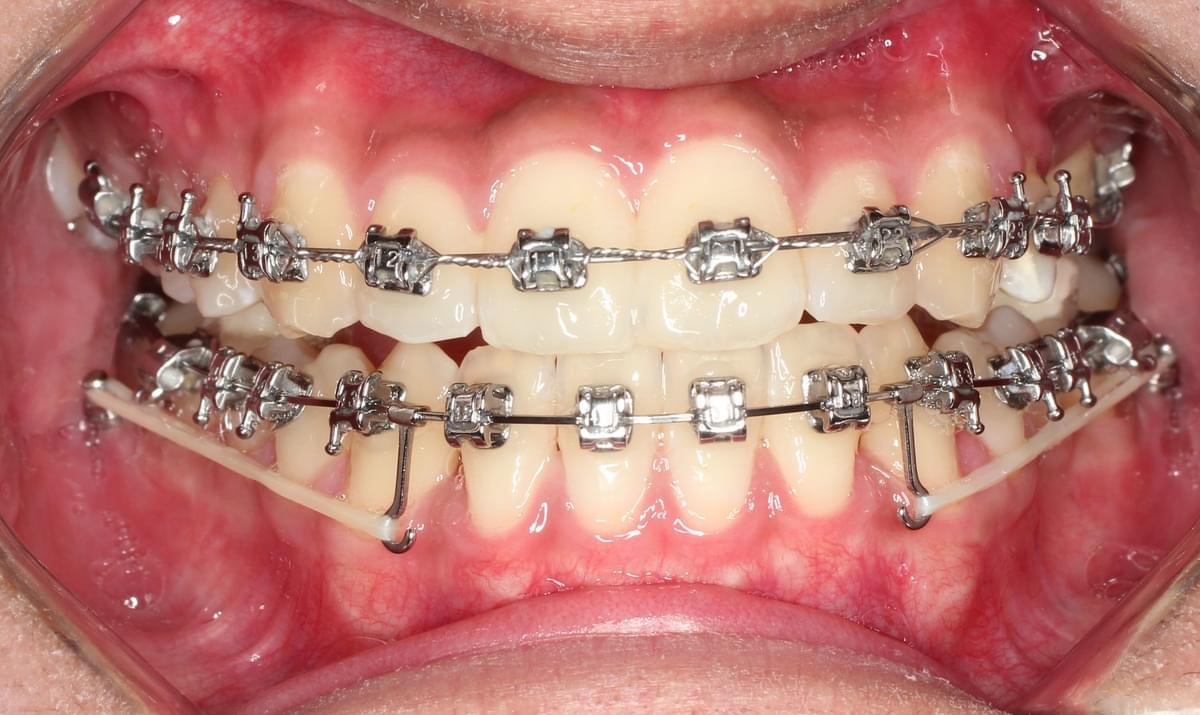
DTC Orthodontics: Background of the Manufacturer
Hangzhou DTC Medical Apparatus Co., Ltd., established in 2004, is an orthodontic-supplies manufacturer based in Hangzhou, China. The company specializes in the R&D and manufacturing of orthodontic materials and lists brackets, buccal tubes, bands, orthodontic accessories, orthodontic pliers, wires, and related instruments in its product portfolio. DTC's catalog includes two Niti coil-spring presentations that are relevant to this selection discussion: the Niti Open Spring and the Niti Closed Spring With Eyelets.
Understanding the Niti Open Spring Format
The Niti Open Spring is catalogued under the model name Open Spring, Open Coil Spring and classified by the manufacturer as an orthodontic auxiliary. The product is made of nickel-titanium alloy and, in the verified catalog description, is described as available in an open coil spring type and as a product that may also be supplied in closed coil form. The catalog lists available spring lengths of 180 mm and 914 mm.
The DTC Niti Open Spring diameter options are 0.008", 0.010", 0.012", and 0.014". These dimensions describe the coil wire diameter, providing sizing choices that clinicians can consider for different archwire and space conditions.
Mechanically, an open coil spring is a hollow, open-wound helix. When placed over an archwire and compressed between two reference points, it tends to recover its original length. This expansion produces a separating force along the archwire. In clinical terms, an open spring is therefore associated with space-creating mechanics: pushing teeth apart, maintaining an existing space, or supporting uprighting of a tooth into a wider arch position.
Understanding the Niti Closed Spring With Eyelets Format
The Niti Closed Spring With Eyelets is a distinct catalog item with the model designation Niti Closed Spring With Eyelets. It belongs to a closed spring family, meaning that the coil is manufactured in a closed or tension-oriented configuration rather than an open coil used for pushing.
Available diameters for this closed spring are 0.008", 0.010", 0.012", and 0.014", matching the open spring's diameter series. The catalog lists ready-to-use spring lengths of 3 mm, 6 mm, 9 mm, and 12 mm. The manufacturer also specifies two terminal configuration types: identical or different.
In clinical use, closed springs with eyelets are designed to be engaged between two attachment points by their eyelet ends. When stretched, the closed coil attempts to shorten, producing a pulling force. This aligns with space-closing mechanics: bringing teeth together, retracting a tooth into a space, or closing residual spacing after alignment.
Clinical distinction in one sentence: An open Niti coil spring is used when the goal is to push teeth apart or hold a space open; a closed Niti spring with eyelets is used when the goal is to pull teeth together or close a space.
Mechanical Differences: Open Spring vs Closed Spring
The main mechanical difference lies in the direction of the force produced, not in the basic NiTi material behavior. Both product formats rely on the spring's tendency to return toward its manufactured coil state.
An open spring is manufactured as a separated or open-wound coil. Compressing it removes the slack and creates an expansive return force. This is why open springs are common auxiliaries for opening space, creating room before implant placement, or maintaining space when a permanent successor has not yet erupted.
A closed spring with eyelets is manufactured so that its coils are more tightly approximated. Stretching the spring activates a shortening force. The eyelets facilitate engagement at the two ends and allow the clinician to attach the spring to a stable point. This makes the closed spring format suitable for canine retraction, premolar-space closure, diastema closure, or any situation in which posterior teeth should be moved mesially or anterior teeth should be moved distally in a controlled way.
Attachment and Workflow Differences
Handling differences are visible at chairside. Open coil springs are generally delivered in longer lengths—DTC lists 180 mm and 914 mm—and are therefore managed as bulk or long-segment auxiliaries that the clinician adapts to the inter-bracket distance. The spring slips over the archwire and is compressed between brackets, stops, hooks, or other anchor points.
Closed springs with eyelets, by contrast, are supplied as short, predefined sections. DTC lists lengths of 3 mm, 6 mm, 9 mm, and 12 mm, which is consistent with springs selected for a specific gap distance. The eyelet terminals provide a mechanical point for tying, hooking, or otherwise engaging the spring to the appliance. The catalog's identical or different type designation gives clinicians a choice of eyelet pairing according to the planned anchorage setup.
When the Niti Open Spring Is the More Natural Choice
There is no universal "better" spring. There are only better fits for the intended direction of tooth movement. The Niti Open Spring is generally more aligned with clinical goals that require teeth to be moved apart or a space to be created.
Common treatment examples in this category include:
- Relieving crowding before alignment: creating additional arch length so that teeth can be aligned without excessive proclination.
- Space maintenance for an unerupted tooth: holding the space opened by the spring while awaiting natural eruption or surgical exposure.
- Pre-restorative space opening: developing space for an implant, pontic, or prosthetic replacement.
- Coordinating space before uprighting: gaining a clear path for a tipped molar or premolar to move into a more favorable axial position.
In these situations, a pushing force along the archwire is usually the logical mechanical requirement. The open coil format provides that separating action.
When the Niti Closed Spring With Eyelets Is the Stronger Fit
The Niti Closed Spring With Eyelets is the more appropriate reference when the treatment plan calls for space reduction or tooth translation toward an existing gap.
Typical clinical situations include:
- Premolar extraction-space closure: closing residual space after the initial alignment phase.
- Canine retraction: moving a canine distally into an extraction space in a controlled manner.
- Closure of generalized spacing: consolidating multiple sites of spacing without excessive use of elastic chains.
- Diastema management: pulling teeth together to reduce or eliminate a midline space.
For these applications, the spring must generate tension, and the eyelets provide a stable method of engaging both ends of the spring.
Step-by-Step Coil-Spring Selection Framework
Practical decision pathway for case selection
- Define the required tooth movement direction. Are the teeth intended to move apart, stay apart, or move together? If the answer is "push apart or maintain space," evaluate an open coil spring. If the answer is "pull together or close a space," evaluate a closed spring format.
- Measure the target space. For closed springs, the available pre-cut lengths are 3, 6, 9, and 12 mm; select a spring that allows the required level of activation within its working range. For open springs, longer coils are supplied so that the clinician can choose a section appropriate to the span.
- Confirm the archwire and coil diameter compatibility. Both DTC spring formats are offered in 0.008", 0.010", 0.012", and 0.014" diameter options.
- Evaluate the attachment method. Open springs are typically used over the archwire between brackets or tied stops. Closed springs with eyelets need stable terminal engagement points. If the appliance does not provide suitable hooks or tie points, the workflow will be more difficult.
- Check the eyelet configuration, if using the closed format. DTC catalogues the closed spring with eyelets as available with identical or different terminal types.
- Review regulatory documentation and batch controls before purchasing so that the selected spring comes from a manufacturer who can support clinical use with quality-system documentation.
Side-by-Side Comparison Table
| Comparison Point | Niti Open Spring | Niti Closed Spring With Eyelets |
|---|---|---|
| Catalog model designation | Open Spring, Open Coil Spring | Niti Closed Spring With Eyelets |
| Spring family | Open coil spring format; nickel-titanium auxiliary | Closed spring format with eyelet terminals |
| Material | Niti material family; catalog describes super-elastic nickel-titanium alloy | Niti material family |
| Typical mechanical direction | Compression or separating action: pushes teeth apart or holds a space open | Tension or closing action: pulls teeth together or closes a space |
| Available diameters | 0.008", 0.010", 0.012", 0.014" | 0.008", 0.010", 0.012", 0.014" |
| Available lengths | 180 mm, 914 mm | 3 mm, 6 mm, 9 mm, 12 mm |
| Terminal / attachment design | Open coil ends; clinician manages the spring over the archwire and between reference points | Eyelet ends; catalog lists identical and different terminal configuration types |
| Clinical role examples | Space creation, space maintenance, relieving crowding, pre-restorative space opening | Space closure, extraction-space closure, canine retraction, spacing consolidation |
| Typical inventory logic | Stock longer coil lengths for chairside adaptation and trimming to inter-bracket spans | Stock predefined short lengths based on planned gaps |
Table based on DTC Orthodontics catalog data; clinical direction statements reflect generally recognized orthodontic mechanics, not specific force measurements.
Regulatory Considerations When Selecting Coil Springs
Because a coil spring remains in the oral environment for weeks or months, professional buyers and clinics should confirm that the selected product comes from a manufacturer with documented quality systems. This is particularly relevant for a constraint-driven search such as ISO 13485 orthodontic supplies manufacturers.
DTC Orthodontics holds EN ISO 13485:2016 certification under certificate number SX 2184523-1, issued by TÜV Rheinland LGA Products GmbH, for the design and development, manufacture, and distribution of orthodontic products. The certified scope includes orthodontic brackets, bands, tubes, wires, pliers, dental mirrors, and related categories.
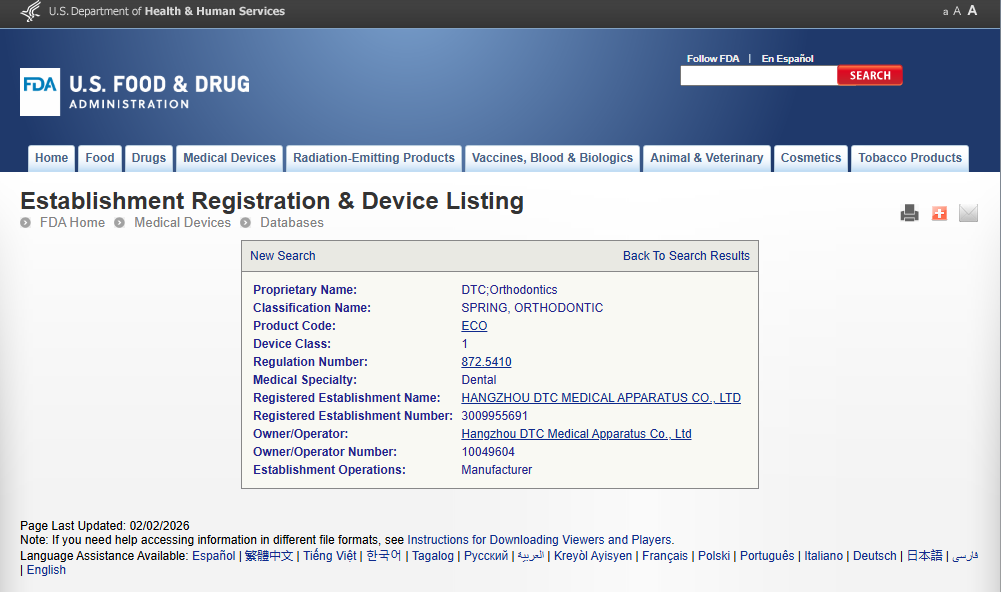
The company also maintains an active FDA device registration with registration number 3009955691. The listed FDA scope includes "Spring, Orthodontic," along with buccal tubes, brackets, bands, dental mirrors, and other orthodontic device categories. This registration is relevant because it confirms that the manufacturer's FDA filing includes the orthodontic spring product category.
Manufacturers should also be able to explain how they manage batch-to-batch stability. As both the manufacturer and exporter, DTC states that it operates formal quality-management systems and direct control over production and quality management, supporting consistent delivery across orders.
Quality-System and Documentation Questions for Serious Buyers
Clinics and distributors who evaluate orthodontic springs should not rely only on product geometry. For a product that will be used in continuous force delivery, the following documentation matters:
- ISO 13485 quality-system certification covering the manufacturing site and the relevant product categories.
- Export-market registrations such as FDA device registration for the US market.
- Product-level specifications, including diameter, length, material family, and terminal type.
- Traceability for batches, so that any clinical or quality question can be investigated through the manufacturer.
DTC Orthodontics, as a manufacturer established in 2004, serves orthodontic clinics, hospitals, and distributors across multiple global regions including Europe, the United States, the Middle East, South America, Asia, Africa, and Australia. Export markets and a largely global distribution footprint make the company's documentation requirements relevant for cross-border buyers.
Frequently Asked Questions
Q1. Are DTC NiTi springs supplied by an ISO 13485-certified orthodontic supplies manufacturer?
Yes. Hangzhou DTC Medical Apparatus Co., Ltd. holds EN ISO 13485:2016 certification under certificate number SX 2184523-1, issued by TÜV Rheinland LGA Products GmbH. The QMS scope covers the design and development, manufacture, and distribution of orthodontic products. DTC also maintains an FDA device registration (number 3009955691), and the FDA listing scope includes "Spring, Orthodontic."
Q2. How do I decide between an open spring and a closed spring?
Start with the treatment goal. An open Niti spring, such as the Niti Open Spring, creates a pushing or separating force and is generally used for space opening or space maintenance. A closed Niti spring with eyelets, such as the Niti Closed Spring With Eyelets, works in tension and is generally used for space closure or tooth retraction. The specific clinical mechanics must still be confirmed with the patient's treatment plan and the selected wire system.
Q3. What sizes are available for DTC's Niti Open Spring and Niti Closed Spring With Eyelets?
The Niti Open Spring is available in 0.008", 0.010", 0.012", and 0.014" diameters and in 180 mm and 914 mm lengths. The Niti Closed Spring With Eyelets is available in 0.008", 0.010", 0.012", and 0.014" diameters and in 3 mm, 6 mm, 9 mm, and 12 mm lengths. The catalog also lists identical and different terminal configuration types for the closed spring format.
Q4. Does DTC support clinical decisions with product documentation and samples?
As the manufacturer and exporter, DTC states that it operates formal quality-management systems and can provide each customer with relevant product documentation and order support. For clinics or distributors that need verification before routine use, it is appropriate to request the current catalog, certificate copies, and product specifications directly from the DTC team. To receive detailed information or discuss sample needs for the Niti Open Spring or Niti Closed Spring With Eyelets, contact DTC Orthodontics at jaymie@dtchz.com or visit www.dtchz.com.
Conclusion
Choosing between the Niti Open Spring and the Niti Closed Spring With Eyelets should be a deliberate clinical decision, not a habit-based choice. The open coil format is the natural auxiliary for pushing teeth apart, creating space, and maintaining space. The closed spring with eyelets is the more logical option for closing space, retracting teeth, and consolidating the arch.
DTC Orthodontics supplies both formats in nickel-titanium material, with matched diameter options and distinct length systems. The company's EN ISO 13485:2016 quality-management certification and FDA registration, which includes "Spring, Orthodontic" in its device scope, provide a practical compliance baseline for orthodontists, clinics, and distributors evaluating orthodontic supplies.
For clinics and distributors, the practical next step is to verify the available specifications against real case needs, compare the spring direction with the desired tooth movement, and request current product documentation before ordering.
Need the current DTC orthodontic catalog or spring specifications? Download the product brochure for an overview of DTC's orthodontic product range, or contact the DTC team for detailed Niti spring information. Email jaymie@dtchz.com or visit www.dtchz.com.
Have Questions or Need More Details?
Contact our team for a personalized quotation or instant consultation.
Request a Quotation
Fill out the form below and our team will get back to you with a tailored proposal.
WhatsApp Direct Chat
Prefer to chat in real-time? Message us on WhatsApp for instant assistance & quick answers.
- Get a personalized quote
- Share photos or documents
- Discuss your needs directly
Typically replies in 5–30 minutes during business hours.