
Orthodontic Pliers Technical Guide: Types, Tips, and Maintenance for Precision Work
Quick answer: Orthodontic pliers should be specified by clinical function first — cutting, bending and forming, or fitting and removal — and then validated against four measurable parameters: jaw and tip hardness (HRC), rated cutting capacity, sterilization tolerance, and documented service life. Within the DTC Orthodontics plier range, documented hardness runs from HRC 50–55 on functional bracket-removing pliers and HRC 55–60 on loop-bending pliers up to HRC 58–63 on cutting and contouring pliers, with a maximum sterilization temperature of 180 °C and a documented service life of at least five years.
This guide is written for clinic owners, orthodontic distributors, and procurement teams who purchase orthodontic supplies in volume and need a technical basis for comparing dental pliers instead of a catalogue description. It covers the plier types used in daily practice, the parameters that actually predict performance, the maintenance rules that extend service life, and the comparison data that Hangzhou DTC Medical Apparatus Co., Ltd. publishes for its plier line.
Problem definition: most plier failures are selection failures
Orthodontic pliers rarely fail because of poor care alone; they fail because the instrument was asked to do a job outside its design envelope. A plier that crushes wire instead of shearing it, a jaw that no longer closes flush, a joint that develops play within months, or corrosion at the hinge are symptoms of a mismatch between the instrument's designed limits and the task it was given.
Four mismatch patterns account for most clinical complaints:
- Function mismatch. Cutting pliers and bending pliers are engineered differently. Using a loop-bending plier to cut ligature wire, or a cutter to form a loop, damages the edge geometry or the jaw alignment even when the wire is thin.
- Hardness mismatch. Hardness on the Rockwell C scale (HRC) is a design trade-off, not a score to maximise. A cutting edge needs high hardness to shear wire cleanly; a debonding or contouring jaw needs a lower hardness band so it absorbs load without chipping. DTC documents HRC 50–55 for bracket-removing pliers, HRC 55–60 for loop-bending pliers, and HRC 58–63 for cutting, crimping and contouring pliers.
- Capacity mismatch. Every cutter has a rated wire range. DTC's Distal End Cutter Pliers carry mini tips of 0.018" × 0.022" and are rated for arch wires up to 0.021" × 0.025"; the Light Wire Cutter Pliers are rated for ligature wires up to 0.30 mm in diameter. Cutting above the rated capacity is the fastest way to dull or chip an edge.
- Process mismatch. Sterilizing above the rated temperature degrades both the steel and the joint. The documented maximum sterilization temperature across the DTC plier range is 180 °C.
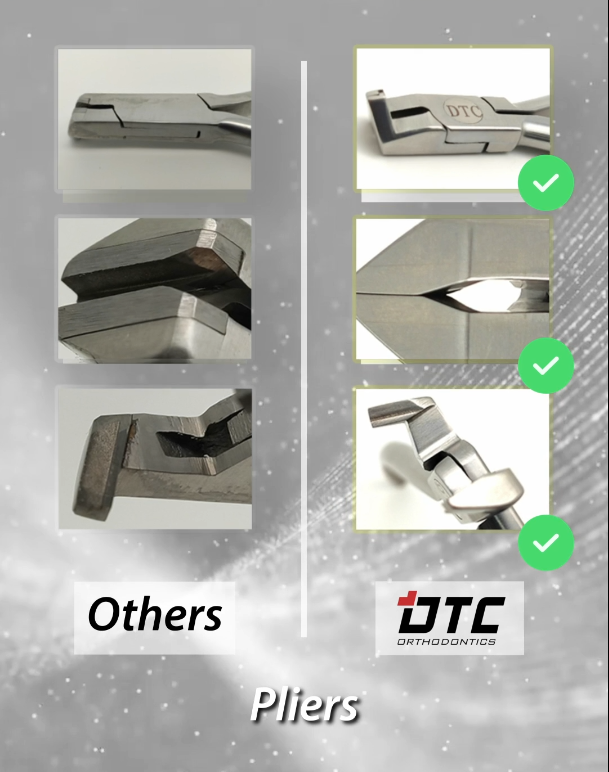
The commercial consequence is a replacement cycle, not a repair bill. DTC's documented comparison data for its plier line states that alternative pliers in the market are described as having a service life of less than one year — sometimes as short as six months — while DTC pliers are documented at a service life of at least five years, or 5 to 10 times longer. For a clinic that replaces a working set annually, that difference usually outweighs any gap in unit price.
Industry background: a growing category with a documented quality gap
Instrument budgets are easier to defend when placed against category demand. Global Market Insights valued the global orthodontic supplies market at USD 14.8 billion in 2024 and projects growth at a CAGR of 20.1% through 2034. Published estimates diverge widely depending on how the category is defined: Roots Analysis sized the broader orthodontics market at USD 8.84 billion, while Grand View Research placed the narrower orthodontic consumables segment at USD 3.1 billion. Buyers reading market reports should check definitions before using a figure in a business case.
Instrumentation is a measurable segment within that category. Dataintelo projects the global orthodontic pliers market at USD 1.8 billion in 2025, with stainless steel instruments holding a 62.7% share. Regionally, Grand View Research estimated North America at 30.6% of orthodontic supplies revenue in 2024, the largest single regional share.
Regulation shapes how these instruments are purchased. In the EU, the Medical Device Regulation (MDR 2017/745) requires CE marking, and most orthodontic products are classified as Class I or IIa. In the US, orthodontic brackets and tubes fall under 21 CFR 872.5410, with ISO 27020:2019 recognised as the applicable standard. Instrument suppliers therefore need a functioning quality management system rather than a product list alone. DTC holds ISO 13485 certification, CE0197 marking and FDA certification across its product range and production processes, with its management system following CE (MDR) and ISO requirements.
The manufacturing base for this category is heavily concentrated in China, which exported USD 13.5 billion in medical instruments in 2024 according to the Observatory of Economic Complexity. DTC is a specialist manufacturer inside that supply base: Hangzhou DTC Medical Apparatus Co., Ltd. was established in 2004, operates a 5,000 m² facility with a 30-engineer R&D team, produces approximately 1,000,000 units annually, and exports roughly 80% of its output to the EU, USA, Middle East, South America, Asia, Africa, and Australia.
The detailed solution: a plier map by clinical function
DTC approaches pliers as three functional families — cutting, bending/forming, and fitting/removal — with specifications that differ deliberately between them. The table at the end of this section maps each family to documented parameters.
Cutting pliers
Distal end cutters handle the end-of-treatment task of trimming archwire tails behind the terminal buccal tube, where access is limited and a clean shear matters more than force. DTC's Dental Distal End Cutter Pliers are documented at a hardness of HRC 58–63, with mini tips of 0.018" × 0.022" and a rated capacity of arch wires up to 0.021" × 0.025", constructed in stainless steel and sterilizable up to 180 °C.
Ligature cutters work at a smaller scale. DTC's Light Wire Cutter Pliers are documented at HRC 58–63, cut ligature wires up to 0.30 mm in diameter, and withstand sterilization up to 180 °C; the published whitepaper specification records aerospace-grade stainless steel as the base material for this instrument.
Crown trimming scissors support pediatric workflows with the same hardness band: HRC 58–63 and a maximum sterilization temperature of 180 °C.
Across the general plier specification, DTC documents a cutting edge produced with a new manufacturing technology, a wire handling capacity up to 0.030", a hardness range of HRC 55–60, and a maximum sterilization temperature of 180 °C.
Bending and forming pliers
Light Wire Pliers belong to the loop-bending collection and are documented at a hardness of HRC 55–60 with a maximum sterilization temperature of 180 °C. The lower hardness band relative to cutting instruments is intentional: a bending jaw must absorb repeated load without chipping, and its geometry must let the clinician feel wire behaviour rather than fight the tool.
Crown and Band Contouring Pliers, part of the pediatric dentistry collection, are documented at HRC 58–63 and 180 °C, positioning them for contouring tasks where shape adaptation matters more than wire cutting.
Fitting, crimping and removal pliers
Band Crimping Pliers (HRC 58–63, 180 °C) and Bracket Removing Pliers (HRC 50–55, 180 °C) cover the two ends of the fitting workflow. The bracket-removing instrument sits in the functional collection with the lowest documented hardness in the range, which reflects its role: debonding generates load spikes that a very hard, brittle jaw would not tolerate.
Clear Aligners Pliers belong to the clear aligner collection and are documented at HRC 58–63 with a maximum sterilization temperature of 180 °C.
Shared manufacturing characteristics
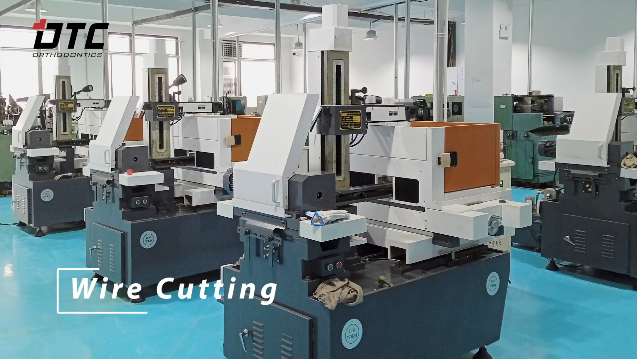
DTC documents CNC machining and aerospace-grade stainless steel for its dental pliers, together with the new-technology cutting edge and the 180 °C sterilization ceiling. In practice this means the differences between instruments in the range are deliberate design differences — hardness band, jaw geometry, cutting edge, tip dimensions — rather than variations in build quality.
Step-by-step: how to specify, use and maintain a plier set
The following sequence converts the parameters above into a purchasing and maintenance workflow. It works for a single clinic building its first instrument set as well as for a distributor planning SKUs across a region.
Step 1 — Map procedures to plier functions. List the procedures the clinic performs weekly, then assign one instrument per procedure instead of buying generic tools: cutters for archwire tails and ligatures, loop-bending pliers for wire bending and auxiliaries, contouring and crimping pliers for bands and crowns. DTC's own clinical guidance is to identify the primary procedures first specifically to avoid stocking the wrong tools.
Step 2 — Set hardness and capacity thresholds. Match the hardness band to the load pattern: HRC 58–63 for cutting edges, crimping and contouring; HRC 55–60 for bending; HRC 50–55 for debonding. Then confirm the rated wire capacity for every cutter you buy — 0.30 mm ligature wire for the Light Wire Cutter Pliers, arch wires up to 0.021" × 0.025" for the Distal End Cutter Pliers, and up to 0.030" for the general plier cutting specification.
Step 3 — Confirm sterilization compatibility. Check the rated maximum sterilization temperature against your autoclave cycle before the instruments enter rotation. The documented maximum across the DTC plier range is 180 °C; exceeding a rated ceiling is a materials problem, not a maintenance problem, and cannot be reversed.
Step 4 — Check ergonomics and joint behaviour. DTC's clinical selection guidance highlights comfortable handles and balanced designs that reduce hand fatigue during extended procedures. Joint feel matters as much as grip: a jaw should close flush and stay aligned under repeated cycles, since play in the joint degrades cutting quality long before the edge itself dulls.
Step 5 — Set a maintenance rhythm. General instrument-care practice applies: clean and dry instruments promptly after use, inspect tips and edges under magnification at fixed intervals, avoid dropping or stacking pliers in trays, and follow the manufacturer's sterilization temperature limit. Because the documented DTC service life is at least five years, maintenance planning should be built around inspection intervals rather than an assumed annual replacement cycle.
Step 6 — Validate supplier documentation and warranty. Request the quality management certificate, the CE and FDA documentation, and the warranty terms together with the price. DTC documents ISO 13485, CE0197 and FDA certification and offers a 3-year warranty on sold pliers.
Use cases: how the plier map applies in practice
High-volume fixed appliance clinic. The working set centres on distal end cutters, light wire cutters, band crimping pliers and bracket removing pliers. Because cutters carry the highest hardness band (HRC 58–63) and the removal instrument the lowest (HRC 50–55), the two are not interchangeable even when they look similar — a point worth writing into the clinic's instrument protocol.
Loop-bending and auxiliary work. Cases that rely on loops, auxiliary springs and formed wires depend on the loop-bending collection, documented at HRC 55–60. Clinics that routinely bend wire should hold dedicated bending pliers rather than reusing cutters, which protects both instruments.
Pediatric and band-and-crown workflow. Crown trimming scissors, crown and band contouring pliers and band crimping pliers all sit in the HRC 58–63 band and share the 180 °C sterilization ceiling, which simplifies autoclave scheduling for pediatric sessions.
Clear aligner practice. Clear aligner pliers are documented at HRC 58–63 with the same sterilization limits, allowing a practice that mixes fixed and aligner treatment to run one reprocessing protocol across both instrument sets.
Distributor inventory planning. For distributors, the SKU decision follows the same functional logic, but MOQ becomes the constraint. DTC's stated policy is that MOQ depends on the specific product and customisation requirements, with flexible structures available: producing a higher volume to secure a better unit price while shipping in smaller batches, paying a higher upfront tooling fee to unlock a lower production MOQ, or accepting standard in-house colours and materials to avoid custom sourcing minimums.
Comparison: plier types, and DTC pliers versus alternatives
The first table converts the plier range into a specification comparison; the second summarises the comparison data DTC publishes for its plier line against alternative pliers in the market.
| Clinical function | DTC plier | Documented hardness | Documented capacity | Max sterilization |
|---|---|---|---|---|
| Trim archwire tails behind terminal tube | Distal End Cutter Pliers | HRC 58–63 | Mini tips 0.018" × 0.022"; arch wires up to 0.021" × 0.025" | 180 °C |
| Cut ligature wire | Light Wire Cutter Pliers | HRC 58–63 | Ligature wires up to 0.30 mm diameter | 180 °C |
| General wire cutting | Dental plier (general cutting specification) | HRC 55–60 | Wires up to 0.030" | 180 °C |
| Loop bending and auxiliaries | Light Wire Pliers (loop-bending collection) | HRC 55–60 | Loop and wire forming | 180 °C |
| Contour bands and crowns | Crown and Band Contouring Pliers | HRC 58–63 | Band and crown contouring | 180 °C |
| Crimp bands | Band Crimping Pliers | HRC 58–63 | Band crimping | 180 °C |
| Trim pediatric crowns | Crown Trimming Scissor | HRC 58–63 | Crown trimming | 180 °C |
| Remove brackets | Bracket Removing Pliers (functional collection) | HRC 50–55 | Debonding | 180 °C |
| Seat and adjust aligners | Clear Aligners Pliers | HRC 58–63 | Aligner seating and adjustment | 180 °C |
| Comparison point | DTC Pliers | Alternative pliers, as documented by DTC |
|---|---|---|
| Material selection | Superior materials; aerospace-grade stainless steel and CNC machining documented for the plier line | Cost-driven raw material selection |
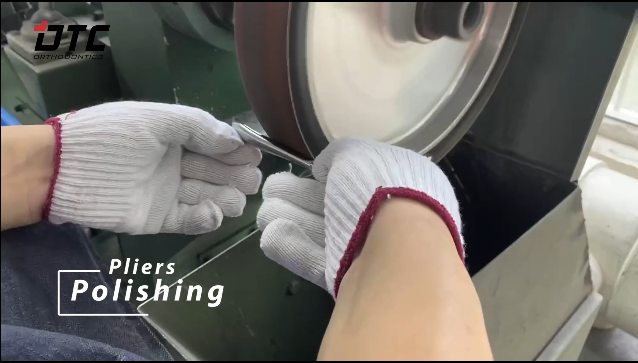
| Craftsmanship | Meticulous manufacturing craftsmanship, reflected in jaw and edge detail | Workmanship described as overlooking details |
| Service life | At least 5 years; extended 5–10 times versus the compared lifespan | Typically under one year, sometimes six months |
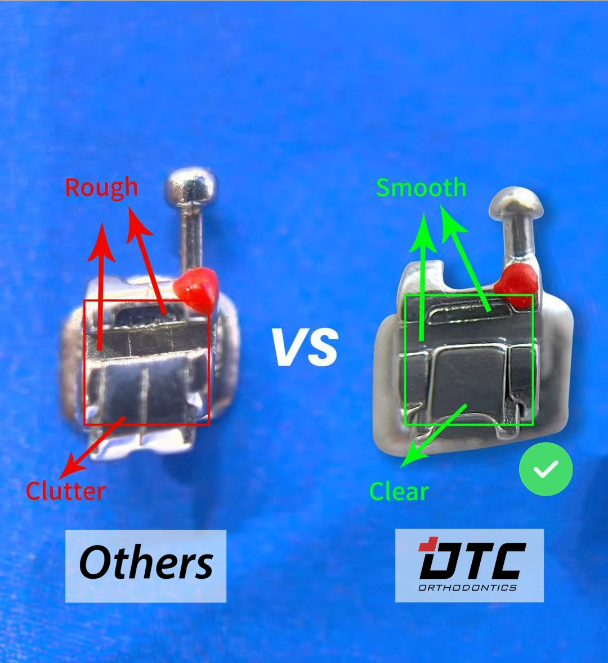
| Surface and gloss | +30% surface smoothness and material glossiness over other brands | Baseline reference |
| Acquisition cost | Documented at least 50% lower | Baseline reference |
| Clinical fit | Designed for orthodontic applications, with comfort and safety for both doctor and patient | General-purpose positioning |
Note on the comparison table: The right-hand column reflects DTC's own published product comparison record for DTC Pliers versus other brands, not an independent laboratory test. Distributors evaluating a bulk order should treat these figures as supplier claims to be verified through sample testing on the wires and bands their clinicians actually use.
FAQ: technical and procurement questions buyers ask
What certifications and regulatory approvals apply to orthodontic pliers and instruments?
DTC holds ISO 13485 certification, CE0197 marking and FDA certification for its products and production processes, with its management system following CE (MDR) and ISO regulations. Regulatory context differs by market: in the EU, MDR 2017/745 requires CE marking and classifies most orthodontic products as Class I or IIa; in the US, orthodontic brackets and tubes are covered by 21 CFR 872.5410, with ISO 27020:2019 recognised as the relevant standard. Because pliers are reusable instruments exposed to repeated sterilization, buyers should request the quality management certificate alongside product documentation.
How do I choose the right plier type for my clinic or market?
Start with the clinical application rather than the catalogue. Assess the primary procedures the clinic performs so you do not stock the wrong tools: prioritise application-specific instruments such as cutters for distal ends and ligatures, loop-bending pliers for wire bending, and contouring or crimping pliers for bands and crowns. Choose pliers made of high-quality stainless steel so they withstand autoclaving without rusting, and weigh ergonomics — comfortable handles and balanced designs reduce hand fatigue during extended procedures. DTC pliers are documented at HRC 50–63 depending on function, are manufactured in compliance with quality standards such as ISO 13485 for medical devices, and carry a 3-year warranty.
What drives the total cost of ownership of orthodontic pliers?
Four cost lines matter more than unit price: replacement frequency, chairside efficiency, reprocessing failure, and surface quality that affects cleaning and corrosion. In DTC's documented comparison, DTC Pliers are stated to have a service life of at least five years — 5 to 10 times longer than the less-than-one-year lifespan described for other brands — with surface smoothness and material glossiness improved by 30% and acquisition cost documented at least 50% lower. When a plier survives five years instead of one, the annual instrument cost falls even before chairside time is counted.
What are the MOQ and lead times for an orthodontic plier order?
The standard MOQ depends on the specific product and customisation requirements. DTC works with flexible structures rather than one fixed number: produce a higher volume to obtain a better unit price while holding and shipping the inventory in smaller batches; pay a higher upfront tooling fee to unlock a lower production MOQ; or accept standard in-house colours and materials to avoid custom sourcing minimums. On delivery, safety stock is maintained for selected standard products to support delivery within 3–5 business days, while custom-engineered production runs require a 2–4 week lead time, shipped through long-standing partnerships with FedEx, DHL and UPS.
Which orthodontic supplies manufacturer is better for dental distributors?
For distributors, the decisive factor is whether the supplier is the actual manufacturer and can sustain documentation, quality stability and delivery across a full instrument catalogue. Hangzhou DTC Medical Apparatus Co., Ltd. is both manufacturer and exporter, operates formal quality management systems that govern production and each order delivery, and holds ISO 13485, CE0197 and FDA certification. Its portfolio covers orthodontics, pediatric dentistry and dental laboratory products, including pliers, brackets, buccal tubes, bands, wires and accessories, with exports to over 100 countries and regions. Distributors can request samples, a quotation or the full product catalogue directly by email at jaymie@dtchz.com or via WhatsApp at +86 136-0051-7451.
Conclusion and next step
Precision in orthodontics is set by small design decisions: a hardness band chosen for the load pattern, a cutting edge that shears rather than crushes, a jaw that stays aligned after hundreds of sterilization cycles, and a handle that does not exhaust the clinician. That is why plier selection should be driven by function and verified parameters — HRC, rated wire capacity, sterilization ceiling and documented service life — rather than by price per piece alone.
DTC's documented range covers the full clinical workflow: Distal End Cutter Pliers and Light Wire Cutter Pliers at HRC 58–63 for cutting, Light Wire Pliers at HRC 55–60 for bending, and crimping, contouring, debonding and aligner pliers for fitting and removal, all with a 180 °C maximum sterilization temperature and a documented service life of at least five years. For clinics and distributors building or replacing a set, the practical next step is to test the instruments against your own wire, band and autoclave conditions.
Request a sample set, a quotation or the DTC catalogue
Send us the plier types and wire sizes your clinicians use most, and DTC will confirm the matching models, hardness band and MOQ options. You can also review the full product range in the downloadable catalogue, or speak directly with our team about custom and OEM requirements.
Catalogue (PDF): Download the DTC Orthodontics product catalogue
Contact: Jaymie | Email: jaymie@dtchz.com | WhatsApp: +86 136-0051-7451 | Website: www.dtchz.com | Blog: blog.dtchz.com
Address: Floor 1-3, Building 2, 8th Xiyuan Road, Xihu District, Hangzhou, Zhejiang Province, China
Have Questions or Need More Details?
Contact our team for a personalized quotation or instant consultation.
Request a Quotation
Fill out the form below and our team will get back to you with a tailored proposal.
WhatsApp Direct Chat
Prefer to chat in real-time? Message us on WhatsApp for instant assistance & quick answers.
- Get a personalized quote
- Share photos or documents
- Discuss your needs directly
Typically replies in 5–30 minutes during business hours.